.png)

.webp)
What Is a Hybrid Attribution Model?
Every CMO has stared at an attribution dashboard and felt something was off. The numbers are clean. The charts look credible. But the story they tell doesn't match what you're hearing from sales, from customers, from the market. That gap isn't a reporting problem, it's a structural flaw in how most B2B SaaS companies measure their marketing.
A hybrid attribution model exists to close that gap. It's an approach to revenue measurement that uses two complementary data layers to map the full customer journey, not just the part your software can see.
Layer one: software-based attribution. This is the tracking your analytics and CRM tools already do , multi-touch, first-touch, last-touch, time-decay, W-shaped, or data-driven models that assign credit to trackable touchpoints like ad clicks, organic search visits, email opens, and form submissions. It's precise, it's automated, and it only captures a fraction of the overall picture.
Layer two: self-reported attribution. This is the data you collect by asking buyers directly which channels, content, conversations, or recommendations influenced their decision. It's typically gathered through open-text fields on demo request forms, post-trial surveys, or sales call debriefs. It's messy, it's qualitative, and it captures what software never will.
The hybrid model uses the software layer as a baseline and adjusts it with self-reported signals. When the two data sources agree, the software says organic search, the buyer confirms they found you through a Google search, attribution is straightforward. When they conflict, the software says direct traffic, but the buyer says a colleague recommended you in Slack, that's where hybrid attribution becomes meaningful. It captures the demand generation touchpoints that software-only models miss entirely.
Think about how a typical B2B SaaS deal actually starts. A prospect hears about your product on a podcast. They mention it to a colleague. The colleague discusses it in an internal Slack thread. Someone from that thread visits your site two weeks later and submits a demo form. Your attribution software records the whole thing as "direct traffic." Hybrid attribution records what actually happened, the podcast sparked it, the peer conversation validated it, and the Slack thread moved it forward. That's a fundamentally different story, and it leads to fundamentally different budget decisions.
Why Traditional Attribution Models Fail in B2B SaaS
If you've ever cut a program that was "underperforming" based on your attribution data and then watched pipeline slow down three months later for no obvious reason, you've already experienced what happens when traditional attribution drives strategy in B2B SaaS.
The problem isn't that attribution tools are bad. They're good at what they do. The problem is that what they do is measure a narrow slice of the buyer journey and present it as the complete picture. For B2B companies with long sales cycles, multiple stakeholders, and heavy dark funnel influence, that narrow slice can be dangerously misleading.
Here's where it breaks down.
They Only Measure Demand Capture, Not Demand Generation
Most attribution systems are designed to track channels that capture existing demand: SEO, paid search, email, and retargeting. These channels convert people who already want to buy. What they don't measure is what generated the demand in the first place, the podcast appearance that planted the seed, the LinkedIn post that reframed a problem, the community thread where someone recommended your product by name.
The core question most attribution models can't answer is: how did this person first become aware that they had this problem and that your product could solve it? If you're only measuring the last few trackable clicks, you're measuring the tail end of a journey that started somewhere your software has no visibility.
They Miss the Dark Funnel Entirely
The dark funnel is all the buyer activity and sharing that happens in channels invisible to analytics software, Slack groups, LinkedIn DMs, WhatsApp messages, internal Teams threads, in-person conversations, podcast recommendations, and community discussions. Studies suggest that the majority of B2B content sharing happens through these private, untrackable channels.
Here's what that looks like in practice. Someone on your customer's team shares your whitepaper in a private Slack channel. Three colleagues read it. One of them visits your site the next morning. Your analytics records a single "direct traffic" visit. The dark funnel influence, the actual reason they showed up is invisible. And it's not just invisible, but it's actively misattributed. That visit gets credited to "direct" or "organic search," reinforcing the false narrative that those are your best-performing channels.
Traditional attribution doesn't just fail to measure the dark funnel.
It lies about it.
Multi-Touch Models Are Still Biased
Multi-touch attribution is the standard upgrade from single-touch models, and it's a meaningful improvement. But it still has a hard stop: it can only distribute credit among touchpoints that software can see.
If you assign credit across five trackable touchpoints using a W-shaped or time-decay model, you're distributing credit among visible interactions while ignoring the invisible ones that may have been more influential. A prospect's buying journey might include twelve touchpoints that your software tracks and thirty that it doesn't. Multi-touch models make the twelve look like the whole story.
The result is a systematic tilt in your data. Demand capture channels look like they're doing all the heavy lifting. Demand creation channels the ones that actually started the journey - get zero credit because they left no trackable footprint. Over time, this bias compounds. You keep funding the channels that get credit, starve the channels that don't, and wonder why pipeline quality declines even as your tracked conversion metrics look fine.
They Ignore Customer Lifetime Value
Traditional attribution stops counting at the first conversion. A customer who clicked a paid ad and signed up for a trial gets attributed to paid. Case closed.
But what if that customer stays for three years? What if they expand their contract twice and refer two other companies who also become customers? Should the paid ad channel still carry all the credit for the initial acquisition while getting zero credit for the expansion and referral revenue it indirectly generated?
Hybrid attribution, particularly when combined with post-onboarding influence mapping, connects initial acquisition channels to long-term revenue impact. It doesn't just ask how someone showed up. It tracks how that relationship evolves and which channels contributed to the full revenue picture, not just the first transaction.
How a Hybrid Attribution Model Works
There's an irony at the heart of B2B attribution. Companies will spend tens of thousands of dollars on software to track buyer behavior, but they won't spend ten seconds asking the buyer what actually happened. Hybrid attribution starts with a deceptively simple idea: trust what you can track, then verify and supplement with what buyers tell you.
It doesn't require ripping out your current attribution stack. It layers on top of it.
Start with your software baseline. Choose a multi-touch model as your foundation - W-shaped works well for B2B SaaS with clear MQL/SQL stages, time-decay works for longer sales cycles. This gives you the trackable journey. It's incomplete, but it's structured and it's consistent.
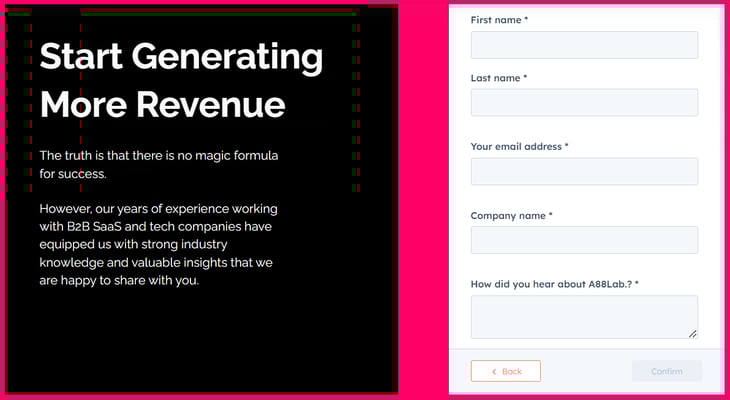
Add the self-reported layer. On every high-intent form (demo requests, trial sign-ups, pricing page submissions), include an open-text field asking how the prospect heard about you. Not a drop-down - an open field. Drop-downs bias responses toward the channels you've listed and systematically miss the ones you haven't thought of. Open text lets buyers tell you about the Slack thread, the internal forward, the conference hallway conversation, the stuff that actually tipped them over the edge. Here's an example of how we do it on our website:
Reconcile conflicts. This is where it gets interesting. When software attribution says "organic search" and the prospect writes "my VP saw your CEO on a podcast and told me to check you out," you now have two data points telling two different stories. The hybrid model doesn't pick one or discard the other. It records both, the visible touchpoint (the Google search) and the invisible catalyst (the podcast). Over time, these conflict patterns become some of the most valuable data in your system, because they reveal exactly where your software-only attribution is systematically wrong.
Extend the lookback window. B2B SaaS buying cycles don't respect your attribution tool's default 14- or 30-day window. A brand awareness effort in Q1 might not produce a demo request until Q3. By then, every trackable touchpoint from the original awareness phase has expired from your attribution model. Self-reported data has no lookback limit. Buyers will tell you about influence that happened six months ago, a conference chat, a podcast episode, a friend's recommendation over dinner. Your software forgot. They didn't.
How to Implement Hybrid Attribution in Your SaaS Demand Gen Program
Most content about hybrid attribution stops at the concept. It tells you why it matters, shows you a few diagrams, and then leaves you to figure out the implementation on your own. That's not useful if you're a marketing leader who needs to actually build this into a working demand gen program.
What follows is the step-by-step process, not theory, not frameworks, but the operational sequence for getting hybrid attribution up and running in a B2B SaaS organization. Some steps take a day. Others take months of data collection before they pay off. All of them are worth doing.
This is where hybrid attribution pays for itself. Not in the data collection, in the budget decisions it changes.
Comment: We have to be honest. In our form submissions we've also received some answers such as "Google" or "Social" without indicating specific campaign, but still gives us better understanding about our campaigns compared to "Direct" traffic.
Tools for Hybrid Attribution in B2B SaaS
One of the biggest misconceptions about hybrid attribution is that it requires a massive tool stack stack or a six-figure analytics investment. It doesn't. Some of the most effective hybrid attribution setups run on a CRM, a custom form field, and a monthly spreadsheet review. The sophistication of your tooling should match your stage, not your ambition.
Here's how it scales:
Entry level (any stage): HubSpot or your CRM + a custom "How did you hear about us?" property on high-intent forms. Pull self-reported data into a monthly report alongside your standard attribution dashboard. Compare. That's it. This alone gives you more insight into dark funnel influence than most Series A–C companies have, and it costs nothing beyond the thirty minutes it takes to set up the property and build the report.
Mid-market: HockeyStack or Dreamdata give you multi-touch revenue attribution with CRM integration, account-level journey mapping, and the ability to overlay self-reported data against trackable touchpoints. These tools are built for B2B SaaS specifically and handle the complexity of multi-stakeholder buying journeys better than generic analytics platforms.
Enterprise: Ruler Analytics, or a custom-built system combining your CDP, CRM, and survey tools. At this level, you can automate the reconciliation between software and self-reported data and build predictive models on the combined dataset. You're not just measuring what happened — you're forecasting which channels will drive pipeline next quarter.
The tool matters less than the process. Hybrid attribution is a measurement discipline, not a software category. If you're waiting for the perfect tool before you start, you're losing months of data you could already be collecting.
What Hybrid Attribution Reveals That Software-Only Models Miss
The most common reaction from marketing leaders who run hybrid attribution for the first time isn't excitement, it's frustration. Not because the model doesn't work, but because it exposes how wrong their previous data was. Three to six months of consistent hybrid data collection will surface patterns that software-only models have been systematically hiding from you for years.
Dark funnel sources become visible. Slack groups, LinkedIn DMs, WhatsApp threads, and private community channels consistently appear in self-reported data as top sources of high-intent pipeline. These channels drive some of the highest-quality prospects you'll ever see, because the recommendation came from a trusted peer, not an ad. Your software attribution will never show you this. It can't. These channels don't generate UTM parameters or cookie trails. They generate conversations, and conversations generate pipeline.
Podcasts and events get proper credit. A prospect who heard your CEO on a podcast and Googled the company name three weeks later shows up as "organic search" in software attribution. Without self-reported data, you'd credit SEO and potentially increase your SEO budget while questioning whether the podcast investment was worth it. Self-reported data reveals the podcast was the actual catalyst, SEO just happened to be the last trackable step in a journey that started somewhere else entirely.
Word-of-mouth becomes quantifiable. "My colleague recommended you" or "a friend in the industry told me about your product" — these are among the most common self-reported sources for high-performing B2B SaaS companies. Without self-reported data, this influence is completely invisible. You can't see it, you can't measure it, and you definitely can't build a strategy around it. With hybrid attribution, word-of-mouth goes from an abstract concept to a measurable pipeline source with real numbers attached.
Internal buying committee discussions surface. This is the deepest layer and the one that changes the most about how you think about your marketing. Conversation-triggered micro-surveys reveal that buying decisions often start in internal team discussions long before anyone visits your website. Someone forwards a post in a Slack channel. A manager mentions a tool they heard about at a conference. A peer shares a comparison doc in an email thread. These internal touchpoints are where vendor shortlisting actually happens, and they're completely invisible to every attribution tool on the market. Only direct buyer feedback can surface them.
Common Mistakes When Building a Hybrid Attribution Model
Hybrid attribution isn't complicated to implement, but there are a lot of mistakes that challenge the model before it has a chance to produce useful data. Most of them come down to the same root cause: treating the self-reported layer as something "optional" instead of a core data source.
Using drop-down menus instead of open text. This is the most common error and the most damaging one. Drop-downs anchor responses to the options you've pre-selected and systematically filter out the unexpected. A buyer who found you through a private Discord community will pick "Social Media" from your list because there's no better option. You'll credit social media. You'll miss the real story. Always use open text for self-reported attribution. The responses are messier to categorize, but they're infinitely more valuable.
Only tracking inbound dark funnel, not outbound advocacy. Most teams build hybrid attribution to uncover how the dark funnel brought prospects in. That's the obvious use case. But almost nobody measures the other direction, how their existing customers are feeding the dark funnel outward. Are your customers recommending you in Slack groups? Forwarding your content to peers? Mentioning you in industry communities? Post-onboarding influence mapping, asking customers two to three weeks after they start using the product if they've recommended you to anyone, and where, is the only way to measure this outbound loop. It's the most underused tactic in attribution, and it reveals your most powerful organic growth engine.
Treating self-reported data as secondary. If your attribution reports still lead with software data in the top half of the dashboard and tuck self-reported data into a footnote at the bottom, you're still letting the incomplete dataset drive decisions. The whole point of hybrid attribution is that neither data source alone tells the full story. Present both side by side with equal weight. When they conflict, don't default to the software data investigate the conflict. That's where the insights live.
Not running it long enough. Self-reported attribution data needs volume before patterns become meaningful. One month of responses is anecdotal. Three months starts to show trends. Six months gives you a dataset you can make real budget decisions on. Teams that evaluate hybrid attribution after four weeks and conclude "it's not telling us anything new" are pulling the plug right before the data gets useful.
Asking the wrong question at the wrong time. "How did you hear about us?" is a high-intent question that belongs on high-intent forms — demo requests, pricing inquiries, contact sales pages. It doesn't belong on newsletter sign-ups or whitepaper downloads, where the prospect isn't making a buying decision yet and won't give you a thoughtful answer. Match the depth of the attribution question to the depth of the conversion event. The deeper the commitment, the more honest and specific the response.
Ready to Fix Your Attribution Model?
If your attribution dashboards are telling you "direct traffic" and "organic search" are your top pipeline sources, there's a good chance you're measuring the last step of the journey and calling it the whole story. The channels that actually created the demand, the conversations, the recommendations, the peer influence, are sitting in a blind spot that software alone will never illuminate.
Book a free funnel analysis. We'll audit your current attribution setup, identify the gap between your software data and what buyers are actually telling you, and build a hybrid attribution roadmap for your demand gen program.
Frequently-Asked-Questions
What is a hybrid attribution model?
A hybrid attribution model combines software-based tracking (multi-touch, first-touch, last-touch) with self-reported attribution data — directly asking prospects and customers how they heard about you — to measure both trackable and untrackable channels across the B2B buyer journey.
How is hybrid attribution different from multi-touch attribution?
Multi-touch attribution assigns credit across multiple trackable touchpoints using predefined rules or algorithmic weights. It's limited to what software can see. Hybrid attribution adds a self-reported layer that captures dark funnel activity, word-of-mouth, community influence, and peer recommendations that multi-touch models miss entirely.
Why does traditional attribution fail for B2B SaaS?
Traditional attribution models were designed for short B2C sales cycles with linear buyer journeys. B2B SaaS buying cycles involve multiple decision-makers, long evaluation periods, and significant dark funnel activity in private channels. Software-only attribution systematically over-credits demand capture channels and under-credits demand creation channels.
What is self-reported attribution?
Self-reported attribution is data collected by asking buyers directly which channels, content, conversations, or recommendations influenced their decision to engage with your company. This is typically gathered through open-text fields on demo request forms, post-conversion surveys, or sales call debriefs.
How do you measure dark funnel with hybrid attribution?
The dark funnel is measured through self-reported attribution data — open-text fields on high-intent forms, conversation-triggered micro-surveys, content-specific attribution prompts, and post-onboarding influence mapping. These methods surface the private channels (Slack, DMs, communities, word-of-mouth) that software cannot track.
What tools are used for hybrid attribution in B2B SaaS?
Common tools include HubSpot (CRM + custom properties), HockeyStack, Dreamdata, and Ruler Analytics for software-based tracking. The self-reported layer requires custom form fields, survey tools, and a process for analyzing the data alongside software attribution reports.