.png)

What you’ll learn in this blog post:
- The 2026 Definition & Market Shift
- The 3-Step Demand Generation Process
- ToFu, MoFu, & BoFu Strategies
- B2B vs. B2C Key Differences
- Common Mistakes: Why Most Campaigns Fail
- FAQ
What is Demand Generation?
Demand generation is the process of creating a predictable pipeline for your sales team by increasing brand awareness and positioning your product as the definitive solution to a specific problem.
In 2026, demand generation has shifted from "gated content" to "ungated education." Our take is that a well-informed buyer is a faster-closing buyer. According to Gartner, 75% of the B2B buying journey now happens before a prospect ever speaks to sales.
Primary tactics include:
- Content marketing: Technical whitepapers and thought leadership
- Paid media: Strategic PPC and LinkedIn ads to stay top-of-mind
- Marketing automation: Precision nurturing based on intent signals
- Account-based marketing (ABM): Hyper-targeted campaigns for high-value accounts
As long as the strategies aim to build demand by creating awareness for your products, acquiring new customers, and re-engaging existing ones, it falls under demand generation.
Now, for it to be effective, the sales and marketing functions of your company need to be transparent and aligned, and both teams should be able to identify any gaps in the process.
The 3-Step Demand Generation Process
Building demand requires a repeatable framework rather than "random acts of marketing."
1. Audience identification
Use ICP (Ideal Customer Profile) data to find who has the problem you solve. Don't just target "Marketing Managers." Target "Marketing Managers at Series B SaaS companies using Snowflake with a churn rate > 5%."
2. Educational distribution
"Atomize" your content. One technical webinar should become 5 LinkedIn snippets, 1 deep-dive essay, and 2 "how-to" videos for Slack communities.
3. Intent Capture
When a prospect visits your pricing page 3 times in 48 hours, that is an intent signal. Trigger a personalized outreach via LinkedIn, not a generic "automated email."
An example: A DevOps SaaS brand creates a free vulnerability scanner. They don’t ask for an email, they let developers find 5 bugs for free. By the time the developer reaches the "limit," they have already proven the ROI to themselves and demand the Enterprise version.
How do ToFu, MoFu, and BoFu drive demand?
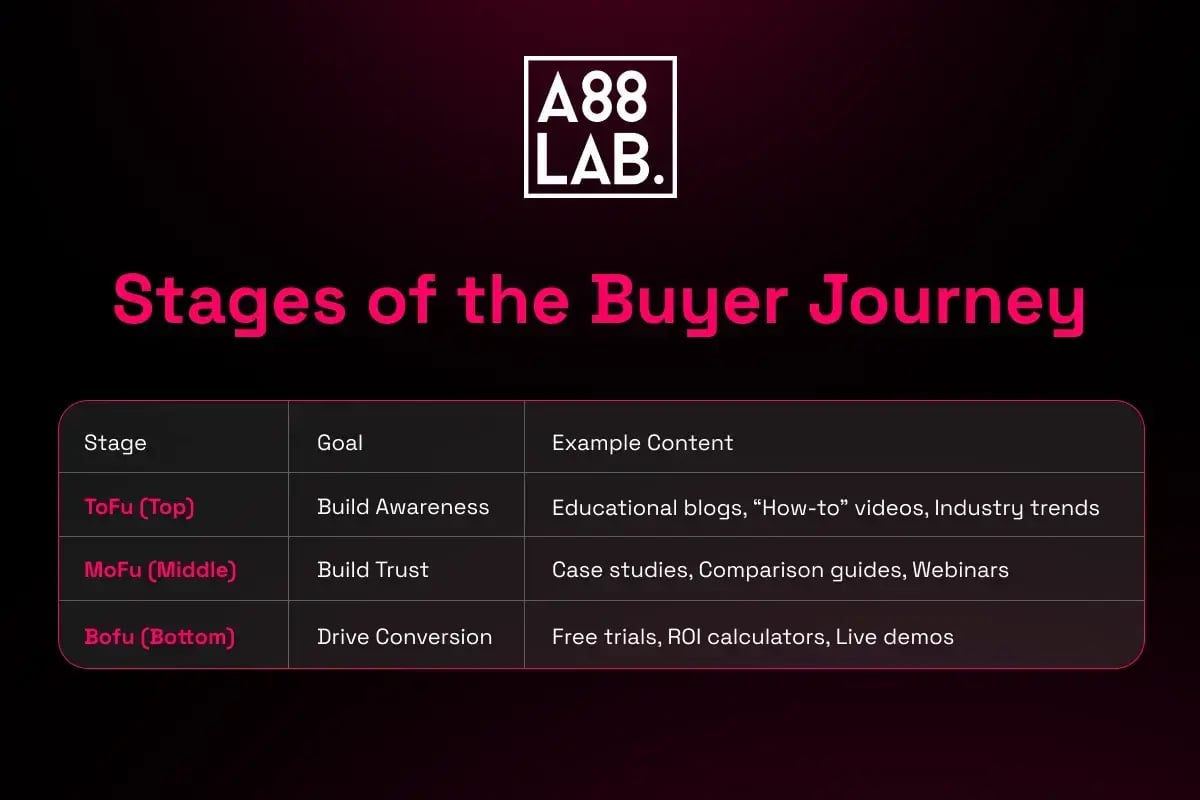
ToFu, MoFu, and BoFu drive demand by delivering specific educational value at every stage of the buyer’s journey, moving a prospect from initial problem awareness to a final purchase decision.
By aligning content with the prospect’s "state of mind," brands can build trust and reduce friction in the B2B sales cycle.
ToFu: Top of the Funnel (Awareness)
- Goal: Build brand authority and awareness.
- Content types: Educational blog posts, industry infographics, thought-leadership videos.
- 2026 strategy: Focus on "ungated" value that solves a small problem for the user immediately.
MoFu: Middle of the Funnel (Consideration)
The MoFu stage drives demand by nurturing leads with personalized content that positions your specific product as the best solution for their needs. As potential customers move down the funnel and you gather intent signals, the focus shifts from general education to specific utility.
- Goal: Engagement and lead qualification.
- Content types: Comparison guides, detailed webinars, and expert whitepapers.
- 2026 strategy: Use interactive tools like ROI calculators to show the cost of "doing nothing."
BoFu: Bottom of the Funnel (Purchase)
The BoFu stage drives demand by providing the final proof points and technical validations necessary to convert MQLs and SQLs into paying customers. This content must explicitly demonstrate your product’s unique value proposition and ease of implementation.
- Goal: Conversion and sales enablement.
- Content types: Customer case studies, live product demos, and technical documentation.
- 2026 strategy: Provide transparent pricing and "implementation blueprints" to de-risk the purchase for the buying committee.
Beyond the Funnel: Retention
In 2026, demand gen doesn't stop at the "closed-won" deal. Post-purchase demand generation involves customer advocacy programs and expansion marketing to ensure existing clients stay and grow.
What are the differences between B2B and B2C demand generaton?
B2B demand generation focuses on multi-stakeholder committees and long and complex sales cycles, whereas B2C focuses on individual emotion and immediate action.
- Decision makers: B2B often involves 6–10 stakeholders (IT, finance, legal). B2C is usually 1–2 people.
- Sales cycle: B2B can take 6–18 months. B2C can take seconds to days.
- Logic vs. emotion: B2B requires heavy "proof of ROI." B2C leans into lifestyle and brand identity.
Common Demand Generation Mistakes
Althouhg there are many mistakes marketers can make, during our experince we've identified three in common:
- Mistaking lead gen for demand gen: Focusing only on "getting emails" rather than "building desire."
- Siloed teams: When Marketing generates "leads" that Sales can't close because they weren't actually "in-demand."
- Ignoring dark social: Failing to account for word-of-mouth in Slack groups or podcasts that don't show up in standard tracking.
Final Thoughts
The B2B Tech world is constantly expanding, especially with the AI and LLM boom tech brands have difficulties finding ways to make themselves stand out from their competitors. For this reason, nailing down your demand generation strategy is more important than ever.
A wrong perception is to beleive that demand generation is a framework that can be replicated for every company in every industry. That's so wrong. You should build your demand generation program based on the stage of your company, your goals, resources, and priorities. It will take you some time to figure out what works best for your business, but once you're there, you will start creating a strong brand environment.
FAQs
1. What is Demand Generation vs Lead Generation?
The primary difference is that demand generation focuses on building brand awareness and category positioning, while lead generation focuses on capturing specific contact information to build a sales pipeline. You cannot effectively capture a lead (lead gen) if the prospect doesn't first want your solution (demand gen).
- Scope: Demand gen is a long-term strategy for the entire lifecycle; lead gen is a short-term tactical goal.
- Content: Demand gen is often "ungated" (free access) to reach more people; lead gen is "gated" (requires an email).
- Metrics: Demand gen is measured by brand search volume and pipeline velocity; lead gen is measured by Cost Per Lead (CPL).
2. What is B2B demand generation and its key components?
A successful B2B demand generation strategy consists of four core pillars: audience identification, content distribution, lead nurturing, and sales alignment. These components work together to make sure you reach the right people with the right message at the right time.
- ICP development: Defining exactly who your "Ideal Customer Profile" is based on firmographics and intent.
- Multi-channel distribution: Using LinkedIn, SEO, and podcasts to meet buyers where they already spend time.
- Marketing automation: Using software to deliver personalized messages based on a user's behavior.
- Analytics & attribution: Tracking which touchpoints actually led to a revenue-generating conversation.
3. How do you measure the ROI of demand generation?
The ROI of demand generation is best measured through "Marketing Sourced Pipeline" and "Customer Acquisition Cost" (CAC) over time. Unlike direct-response ads, demand gen ROI often shows up as a decrease in sales cycle length and an increase in average deal size.
- Pipeline velocity: How quickly a prospect moves from "aware" to "closed-won."
- Share of voice: Your brand's visibility in the market compared to competitors.
- Contribution to revenue: The percentage of closed deals that originated from marketing-driven awareness.
4. Why is demand generation important for B2B tech brands?
Demand generation is key for tech brands because B2B involves complex problem-solving and multiple decision-makers who require deep education before they trust a vendor. In a crowded 2026 marketplace, tech brands cannot survive on "cold calls" alone, they must create a "pull" effect through authority.
- Complex sales: High-ticket software requires consensus from IT, Finance, and Legal.
- Brand trust: Buyers are more likely to choose a brand they have seen consistently providing value on social media or search.
- Market crowding: Demand gen differentiates your product by highlighting unique use cases that competitors miss.
5. How does "Dark Social" impact demand generation?
Dark Social refers to the "invisible" ways demand is created: private Slack groups, word-of-mouth, podcasts, that traditional tracking software cannot attribute to a specific link click. In 2026, most demand generation happens in these spaces.
- The attribution gap: Your CRM might say a lead came from "Direct Traffic," but they actually heard about you on a podcast.
- Community building: Successful brands participate in communities where their buyers hang out without "selling."
- Self-reported attribution: To measure this, add a "How did you hear about us?" field to your demo request forms.
6. What is the role of content distribution in demand generation?
Creating high-quality content is half the battle, distribution is what generates demand. Content distribution makes sure your insights reach your target audience where they already consume information, rather than waiting for them to find your website.
- Content atomization: Taking one long-form asset (a webinar or a whitepaper) and breaking it into 10+ social posts, short videos, and newsletters.
- Paid social amplification: Using targeted ads (like LinkedIn Sponsored Content) to ensure your best-performing organic content reaches a wider slice of your ICP.
- Zero-click content: Providing the "value" of the content directly in the social post or email so the user doesn't have to click a link to learn something new.
.png)